
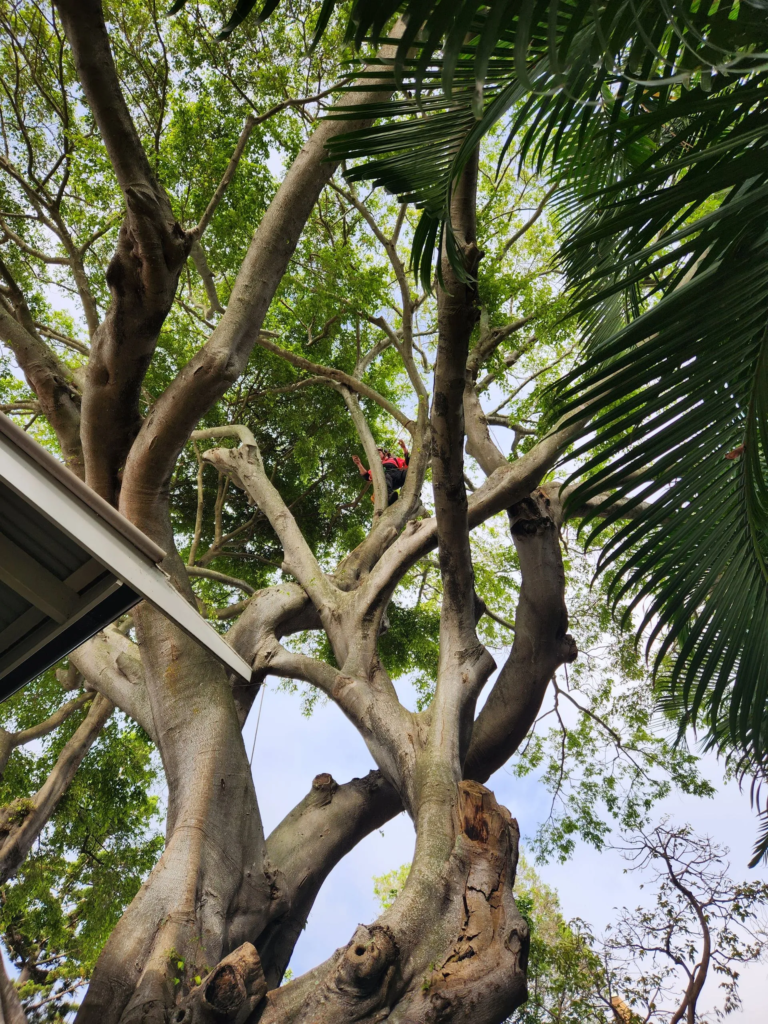
Trimming is the everyday work. Branches off the roof, out of the gutters, back from the pool, clear of the driveway and away from the fence line.
It is not a big dramatic job, but it is the one that stops the big dramatic jobs happening later.
Branches on the roof. Limbs resting on tiles or Colorbond wear through the surface and lift ridge caps. They also give possums and rats a bridge straight into your roof space. Two to three metres of clearance is the sensible target.
Gutters full of leaf. If a tree overhangs the gutter, you will be up the ladder every couple of months, and blocked gutters in a Gold Coast downpour push water back under the eaves. Trimming back from the roofline fixes it at the source.
Pool clearance. Leaves and fruit into the pool means filter cleaning every week and more chemicals. Trimming the overhang cuts the workload right down.
Driveway and access clearance. Low limbs that scrape the ute, block a caravan or make you duck on the way to the bin. Common on acreage driveways through Bonogin, Tallai and Worongary.
Powerline and service clearance. Branches near the service line running to your house. Important, and there are rules about it, covered below.
Fence lines and neighbours. Limbs over the boundary, or a neighbour’s tree over yours. We deal with a lot of these, and there is usually a straightforward fix once someone actually looks at it. They come up most in the newer estates where houses sit close to the boundary.
Solar panels. Shade cutting your output, and leaf litter sitting on the panels.
People use the three words interchangeably, which is fine, but they are different jobs.
Trimming is clearance work. Getting branches away from something they should not be touching.
Pruning is health and structure work, cutting to AS4373 to keep the tree sound long term.
Lopping is size reduction, and if it is done as a proper crown reduction it is fine.
The reason it matters is that even a trim needs the cuts to be made correctly. A clearance cut in the wrong place still leaves a rotting stub. We trim to standard, so the tree stays healthy while it stops touching your roof.
The line running from the street to your house is the consumer mains, and vegetation near it is regulated in Queensland. Untrained people should never work near it, and every year someone tries and it goes badly.
There is a difference between the network provider’s lines and the ones on your property, and who is responsible for what depends on which is which. Energex handles vegetation around its own network. Work near the line running onto your property is a different matter again, and some of it can only be done with the power isolated by arrangement.
We look at it during the quote and tell you plainly which category you are in, what we can do, and what has to go through Energex. What we will not do is guess. People are killed doing that every year in Queensland.
Free onsite quote, booking confirmation, live tracking on the day so you are not waiting around.
Most trims are quick. The crew sets up, the climber makes the cuts, material goes through the chipper as it comes down, and the site is raked and blown clean. Gutters get checked if we have been working over the roof.
You do not usually need to be home, as long as we have access and side gates are unlocked.
Trimming is at the cheaper end of tree work. Fewer hours, less green waste, less rigging.
Our team rate is $660 per hour across an eight hour day, and most trims are quoted as a fixed price. If you have several trees needing clearance, doing them all in one visit is significantly cheaper than separate call-outs.
If you are on the fence about timing, before storm season is the answer. October is busy for good reason
Two to three metres is a good working target. That keeps limbs off the tiles in wind and stops possums and rats using the tree as a bridge into the roof.
In Queensland you generally can cut back to the boundary at your own cost, but there are rules, and protected trees complicate it. We will look at it and tell you where you stand before anything is cut.
Fast growers on the Coast usually need clearance work every one to two years. Slower species can go longer. We will give you a realistic interval for your trees.
We will assess it and tell you what is possible and who is responsible for which section. Never attempt it yourself.