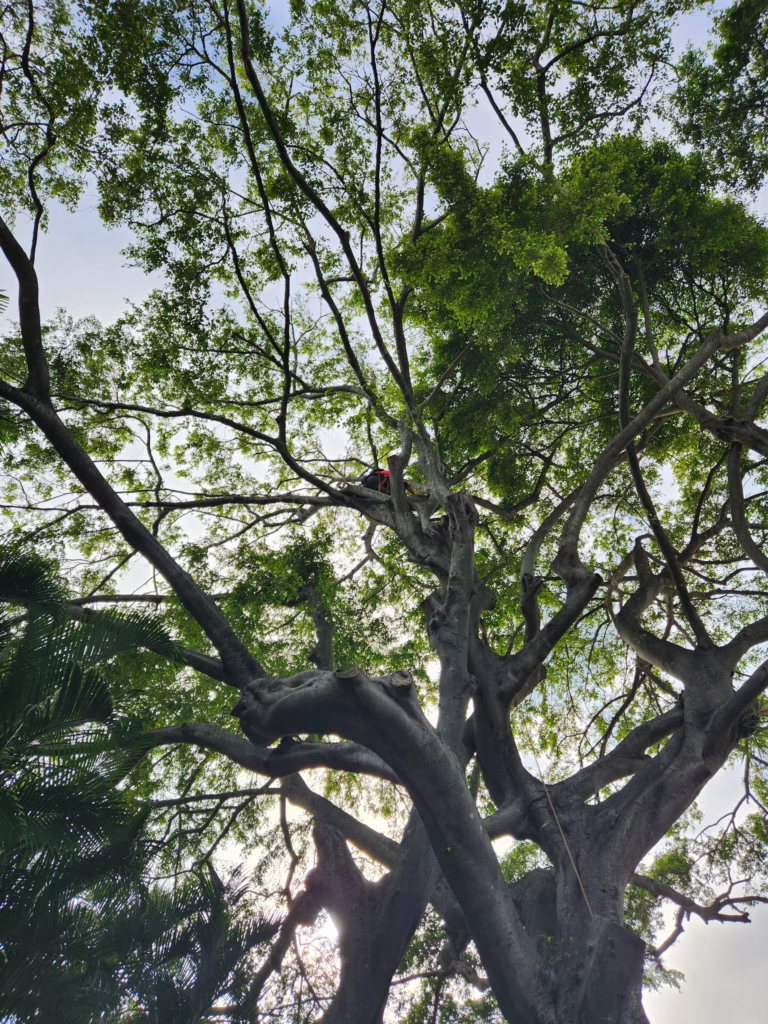
Pruning is the part of this trade where the difference between a good operator and a cheap one shows up most clearly, and it does not show up on the day. It shows up two or three years later.
We prune to AS4373, the Australian Standard for pruning amenity trees. Here is what that actually means, without the jargon.
Cut in the right place. Every branch has a slightly swollen collar where it joins the trunk or the parent limb. That collar contains the tissue the tree uses to seal a wound. Cut outside it and you leave a stub that rots. Cut into it, a flush cut, and you have taken away the tree’s ability to close the wound at all. The correct cut sits just outside the collar, and it seals over in a season or two.
Take the right branches. Deadwood, crossing limbs rubbing each other, weakly attached forks, branches heading for the roof. Not simply the ones easiest to reach from where the climber happens to be standing.
Do not take too much. Roughly a quarter of the live canopy is a sensible maximum in one go on a healthy tree, less on a stressed or older one. Leaves are how a tree feeds itself, so removing too many puts it into deficit and it responds with stress growth.
Never top a tree. Cutting the main stems back to stubs is the single most damaging thing you can do to a tree, and it is still common.
That is the whole standard, really. It is not complicated. It just takes longer, because the climber has to move through the canopy to reach the right cuts instead of working the outside edge.
Deadwood removal. Dead limbs in the canopy of a big gum are the most common cause of storm damage we see, and they are entirely predictable. Taking them out before November is cheap insurance.
Crown thinning. Selectively removing some inner growth to let wind pass through the canopy instead of pushing against it like a sail. On exposed hinterland ridgelines this genuinely reduces the chance of failure.
Crown lifting. Taking the lowest branches off to get clearance over a driveway, a lawn or a footpath, without changing the shape of the tree.
Crown reduction. Shortening the canopy back to suitable side branches to reduce size and weight. This is what people are usually asking for when they say lopping.
Structural pruning on young trees. Cheapest work we do and the most valuable. Correcting a co-dominant fork on a five year old tree takes twenty minutes. Dealing with the same fork when it splits at fifteen metres costs thousands.
Formative and remedial work. Trees that have been badly cut in the past can often be brought back over a few years of correct pruning.
The big hinterland eucalypts, spotted gums, tallowwoods and flooded gums, drop limbs when they carry deadwood, and there are a lot of them across Bonogin, Tallai and Worongary .
Poincianas and jacarandas grow wide and heavy with weak branch attachments, and they need weight management rather than hacking.
Camphor laurels get enormous and are usually in the wrong place. Mangoes and avocados in older backyards get too tall to pick and benefit from proper reduction rather than a hedge trim.
Figs, including the mature ones through Benowa and Nerang, need experienced hands. They respond well to correct pruning and badly to guesswork.
Free onsite quote, with live tracking so you know when we are coming. We look at the tree and tell you what it needs, which is sometimes less than you expected.
On the day the climber sets up rope access and works through the canopy. On tight blocks limbs are lowered rather than dropped. Material is chipped as we go, then the site is raked and blown down.
Afterwards the tree should look like a tree, not like a tree that has had something done to it. That is the test.
Our team rate is $660 per hour over an eight hour day, or $4,400 for a discounted full day. Most residential pruning is quoted as a fixed price.
Pruning is cheaper than removal, and pruning a tree regularly is cheaper again than dealing with a neglected one. If a tree has not been touched in fifteen years, the first visit costs more than the ones after it.
It is the Australian Standard for pruning amenity trees. It sets out where to cut, what to remove and how much can safely be taken. Pruning to it keeps the tree healthy and lets wounds seal properly.
Deadwood and hazard removal can be done any time. Structural pruning on most Gold Coast species is best outside the peak of summer heat and before storm season. We will advise on your specific tree.
As a guide, no more than about a quarter of the live canopy on a healthy tree, and less on a stressed one. If more needs to come off, staging it over two visits is safer for the tree.
Usually, yes, and you keep the shade and the value the tree adds. We will tell you honestly if a tree is past the point where pruning helps