
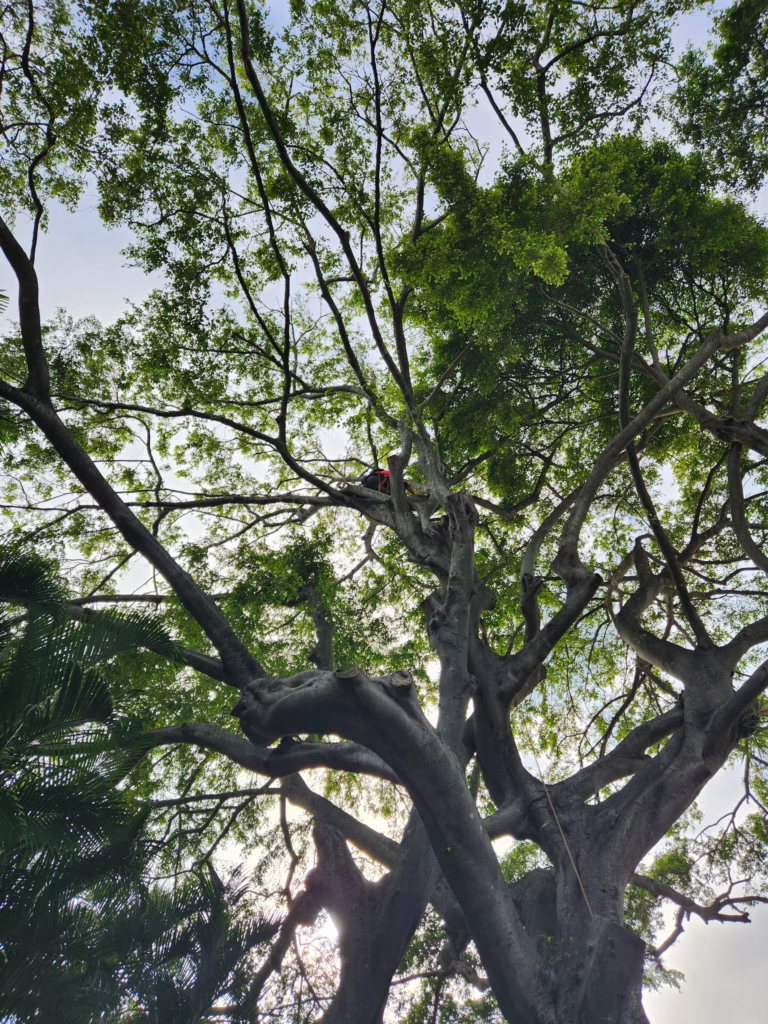
South East Queensland storm season runs from about November through March, and the Gold Coast gets the full treatment: severe thunderstorms off the ranges, tropical lows, and the occasional system that parks over the hinterland and dumps 200 millimetres in a night.
Trees come down. We deal with the aftermath, and we handle the insurance side properly so you are not fighting a claim on top of everything else.
If a tree is down right now, ring us on 0480 473 902. If powerlines are involved, call 000 and Energex on 13 19 62 first.
It is rarely just the wind.
Saturated soil. The failure mode we see most on the Gold Coast is not a snapped trunk, it is a whole tree tipping over. Days of rain turn the soil to soup, the root plate loses its grip, and then a moderate gust is enough. This is why the worst damage often comes at the end of a wet week rather than during the biggest single storm.
Deadwood in the canopy. Dead limbs are brittle and let go first. They are also completely predictable months in advance, which is the frustrating part.
Co-dominant forks. Two stems of similar size growing from one point, with bark trapped in the join. They split, usually right down the middle of the tree, and often onto whatever is beneath.
Existing decay. Fungal brackets at the base, old wounds, past bad pruning. The tree looked fine from the driveway because the problem was inside it.
Sail effect. A dense untouched canopy catches wind like a sail. Thinning the crown lets air through and takes load off the roots.
Make it safe. Fallen trees are under tension. What is holding what has to be worked out before anything is cut, and cutting in the wrong order is how people get seriously hurt.
Get the weight off. Trees on roofs, on fences, on cars, across driveways and on powerline service runs.
Deal with the partial failures. Hung-up trees, cracked limbs still attached, and root plates that have lifted. These are more dangerous than trees that have already landed, and they are the ones people underestimate.
Document everything. Dated photos before we touch anything, during the works and at completion.
Clean up and cart away. Everything is chipped into the mulch truck, not left in a pile for council collection that may not come for weeks.
This is where people get stuck, so here is how it usually works.
Most policies cover removing a tree off an insured structure, and commonly the cost of clearing the debris. What is often not covered is removing a tree that came down without hitting anything, or the cost of replacing the tree itself. Every policy is different, so read yours or ring your insurer before you assume.
Photograph everything before anything is moved. This is the single most useful thing you can do. Insurers ask, and once the tree is cut up you cannot recreate it. If it is not safe to get close, take photos from a distance.
We provide what the insurer wants. A written scope of works, itemised costs, dated photographs of the damage and the works, and a description of the failure. If your insurer wants a formal opinion on cause of failure, we can provide an arborist report.
We can deal directly with your insurer or builder where a claim is already lodged and someone else is coordinating the make-safe. Tell us who to send the scope and photos to and we will send them straight through rather than making you the go-between.
Almost every storm failure we attend was predictable in September.
Deadwood out of the canopy, crown thinning on exposed trees, structural issues identified and dealt with, and any tree already showing decay assessed properly. A pre-season inspection costs a fraction of an emergency call-out, and there is no insurance excess attached to it.
October is the month to do it. By late November everyone is booked.
For body corporates and strata, a pre-season assessment across the whole complex is free.
Usually yes when the tree has hit an insured structure, and often the debris removal too. Cover for a tree that fell without hitting anything varies a lot. Check your policy or ring your insurer, and photograph everything before it is moved.
We hold capacity for urgent work and prioritise trees on structures and blocked access. After a large storm cell the whole Coast rings at once, so we triage by risk.
Yes. Dated photos, a written scope of works, itemised pricing and, where required, a formal arborist report on the cause of failure.
September or October. It costs far less than emergency work, and by late November the calendar is full.