Worongary sits in the gap between the coast and the hinterland, and its blocks reflect that. Rolling acreage, horse properties, big open paddocks with mature trees left standing in them, and pockets of retained bushland on the higher ground.
It is ten minutes from our base in Bonogin, it is one of the suburbs we know best, and we cover the full service list here.
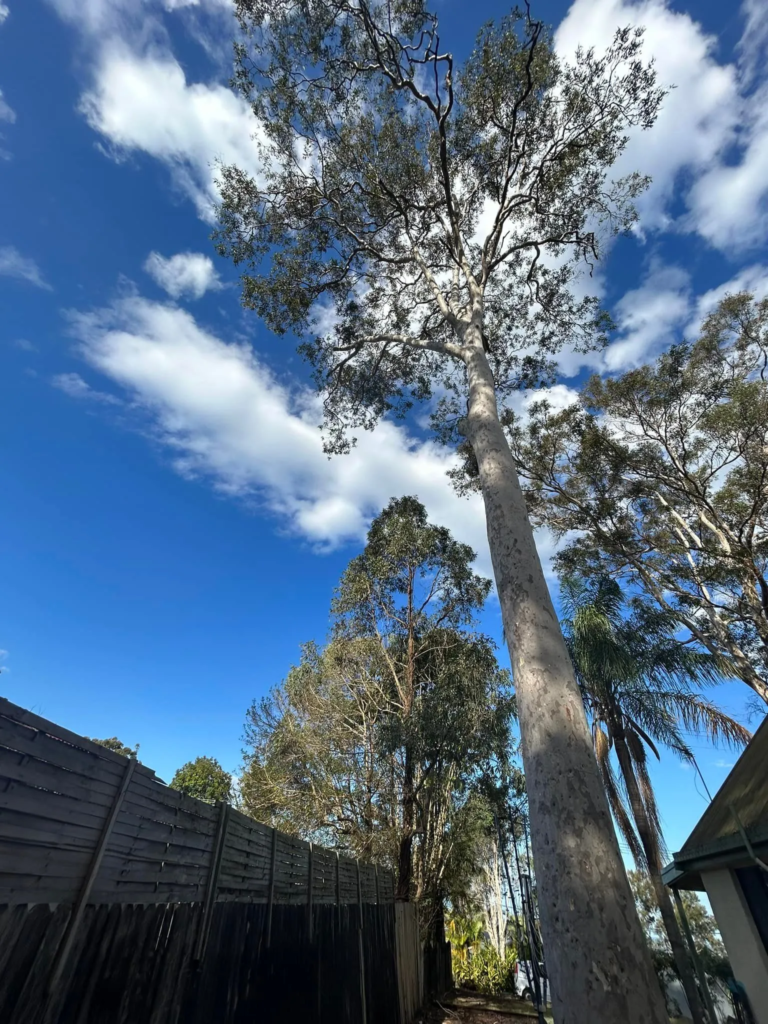
The classic Worongary job is a large eucalypt standing alone in a paddock, or a line of them along a fence or driveway.
People assume an isolated tree is the easy version. It is often the opposite. A tree that has grown in the open with no competition develops a wide spreading canopy and heavy horizontal limbs, rather than the tall straight form of a tree grown in forest. Those long lateral limbs carry a lot of weight a long way from the trunk, which is exactly the configuration that fails.
Open grown trees have also never been wind-trained by surrounding trees, so when a paddock is cleared around them or a neighbouring block is developed, previously sheltered trees suddenly take loads they have never seen. We get called to a lot of failures that trace back to that.
The species through here are the usual hinterland hardwoods: spotted gum, tallowwood, forest red gum, grey ironbark, with brush box and remnant scrub in the gullies.
A good number of Worongary blocks run horses, which adds real constraints, and they are constraints we are used to.
Horses have to be moved and confined before we start, and they need to stay away from the work area for the duration. Chipper noise carries and startles stock. Fencing has to be intact when we leave, so if a section comes down for access it goes back up.
Worth knowing as a horse owner: some tree species are toxic to horses, and dropped material is more of a risk than a standing tree because wilted leaves are more palatable and, in some species, more dangerous. We do not leave cuttings in a paddock with stock in it, and if there is anything on your place worth knowing about we will mention it at the quote.
Parts of the Worongary and Mudgeeraba hinterland fall inside mapped koala habitat and corridor areas, which adds a layer on top of the standard vegetation rules and can affect what is approvable.
If you are on acreage with retained bushland, it is worth knowing before you plan anything rather than after you have paid for an application. We check the mapping for your address at the quote.
Worongary access issues are different to the driveway problem in Tallai. Here it is usually distance and ground conditions rather than gradient.
Long driveways, gates that are narrower than they look, paddocks that turn soft after rain, dams and drainage lines between the tree and the road. The Avant loader is the machine that solves most of this, because it carries heavy timber across soft ground without cutting it up and it fits through gaps that stop a tractor.
Removals of large paddock and boundary trees. Deadwood and structural pruning before storm season, which on open grown trees with heavy laterals is the highest value work you can buy. Driveway and fence line clearance. Stump grinding, including old stumps left behind years ago that catch the slasher. Storm response when a paddock tree goes over.
On acreage, the clean-up conversation goes differently to the suburbs.
Plenty of Worongary clients want the timber left, cut to length for firewood, and the mulch dropped somewhere useful rather than carted away. That suits us, because every cubic metre we leave behind is one we do not have to process and tip. It usually brings the price down.
Tell us at the quote, not on the day. Where the timber goes and how it is cut changes how the crew works, and it is much easier to plan for than to change halfway through.
Not necessarily. Open grown trees develop heavy horizontal limbs that carry weight a long way from the trunk, and that structure is more failure prone. The removal is often more technical than people expect, though there is usually more room to work.
Yes, before we arrive. Stock needs to be confined away from the work area for the duration, and we will not leave cuttings in a paddock with animals in it.
It can. Parts of the Worongary hinterland sit in mapped koala habitat and corridor areas, which adds requirements on top of the standard vegetation rules. We check the mapping for your block before quoting.
Usually. The Avant articulated loader spreads its weight and handles soft ground far better than a tracked machine. If conditions are genuinely too wet we will tell you and reschedule rather than wreck your paddock.